CADeT
Causal-Aware Deformation Transmission for Indirect Robotic Manipulation of Soft Tissue
Manipulate an accessible tissue to move a target that the robot cannot grasp directly. CADeT uses tissue responses and targeted probing to infer how deformation is transmitted, then adapts indirect shape control to that interaction.
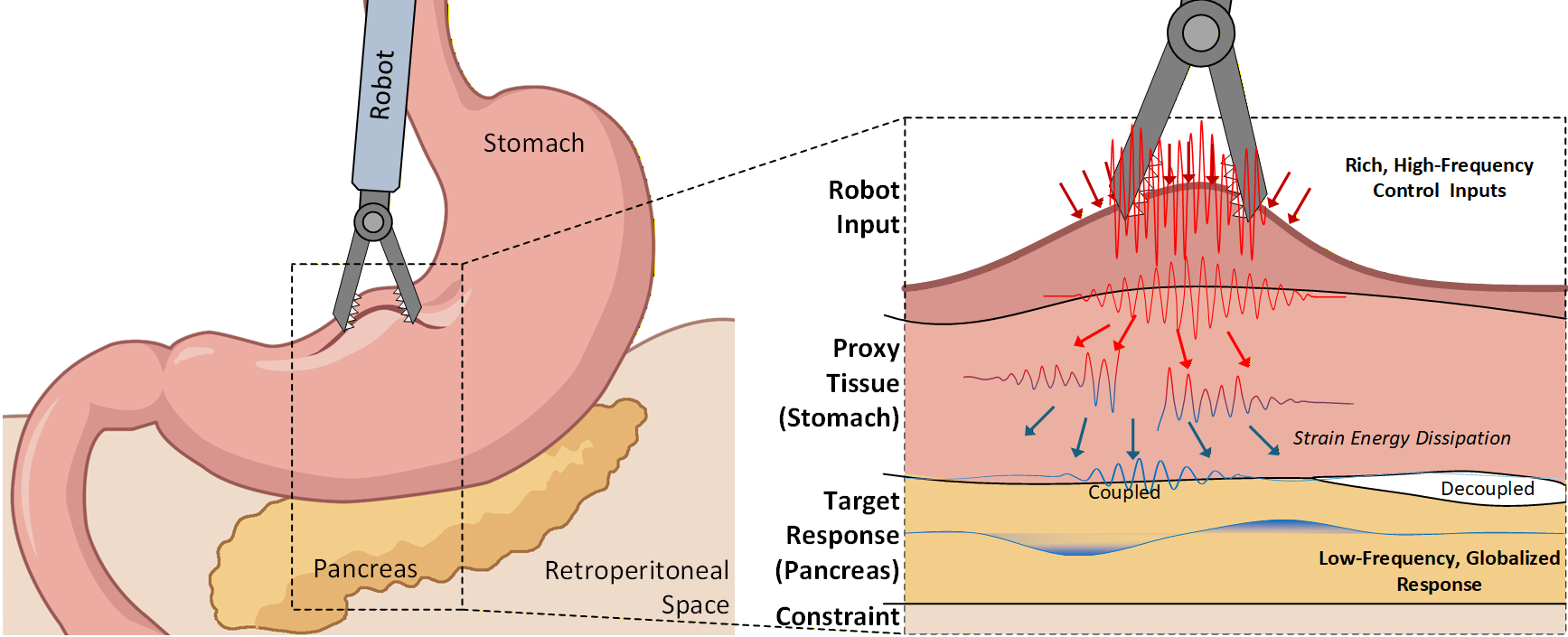
The same target response can have different causes
A target that barely moves may be disconnected from the manipulated tissue, or attached but blocked by its surroundings. CADeT maintains a belief over three transmission modes:
| Mode | Interaction | Target response |
|---|---|---|
| Decoupled | Ineffective proxy–target coupling | Little transmitted motion |
| Coupled | The proxy transmits deformation | The target responds to proxy motion |
| Blocked | The coupled target meets an external constraint | Motion is restricted |
- Observe and infer. Track the proxy and target tissues, updating the transmission-mode belief from their responses.
- Probe when ambiguous. Choose an additional action whose predicted responses help distinguish competing modes.
- Control through the proxy. Combine the belief with an online estimate of the adhesion Jacobian in model predictive control.
Method details: Sections IV–VI of the paper.
Results at a glance
In the paper's simulation evaluation, full CADeT achieved:
Simulation results: 149/150 trials correctly identified. Manipulation statistics are reported separately in Table III. Source: Section VII, Tables I and III.
Physical experiments used the da Vinci Research Kit with tissue phantoms and ex vivo porcine tissues. In the three nominal reachable Coupled cases, final mean shape errors were 2.1–2.7 mm (Table V).
Experiment videos
Each clip contains one complete demonstration with its original plots and playback speed. Use the controls to pause, seek or view fullscreen.
Each excerpt is 25 seconds long. On-screen experimental time can differ from video playback time.
Pancreatic manipulation through the stomach
The stomach is the accessible proxy; the pancreas is the indirectly manipulated target. Paper: Section VIII-B.
Mesenteric manipulation through the colon
The robot manipulates the colon to control the attached mesentery. Phantom trials use a simplified intestinal model. Paper: Section VIII-C.
Simulation: three transmission conditions
Controlled attachment and blocking conditions illustrate Decoupled, Coupled and Blocked interactions.
Citation
@misc{hu2026cadet,
  title = {{CADeT}: Causal-Aware Deformation Transmission for
           Indirect Robotic Manipulation of Soft Tissue},
  author = {Junlei Hu and Dominic Jones and Pietro Valdastri},
  year = {2026},
  eprint = {2609.38483},
  archivePrefix = {arXiv},
  primaryClass = {cs.RO},
  url = {https://arxiv.org/abs/2609.38483}
}